Why does Santa Barbara have so many red tile roofs?
Because the city decided to look that way, then wrote it into law.
Checked against city records and local history
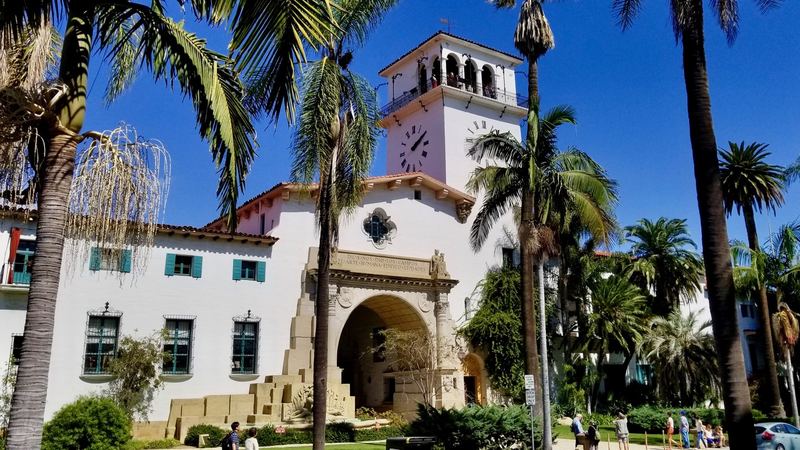
Photo: John Stanton, CC BY-SA 3.0

Civic boosters were already pushing a Spanish look in the early 1920s. The June 29, 1925 earthquake knocked down most of downtown and gave them the rebuild. Since 1960, buildings in the old-town district have had to follow the style, down to the kind of tile.
Downtown before the quake
Downtown in the early 1920s was mostly Victorian, with brick and masonry fronts (National Park Service). In 1922 the Community Arts Association started a Plans and Planting Committee to campaign for better architecture (City of Santa Barbara). Its leaders, Bernhard Hoffmann and Pearl Chase, wanted the town to look like its Spanish and Mexican past again (City history).
Hoffmann had already started a sample. From 1922, by arrangement with the de la Guerra family, he built El Paseo, a Spanish-style complex of shops onto the back of the old Casa de la Guerra adobe (SB Trust for Historic Preservation).
The June 1925 earthquake
At 6:42 a.m. on June 29, 1925, the shaking lasted eighteen seconds. The Mission's twin towers fell, and 85 percent of downtown's commercial buildings were destroyed or badly damaged (SB Historical Museum). Most of what came down was unreinforced masonry. Because it was early, most people were still home in wood houses, and the records count 11 to 13 deaths (City history, National Park Service).
Rebuilding in the Spanish style
Right after the quake, the city set up an Architectural Board of Review to check rebuilding designs (City of Santa Barbara), the first in the country (Downtown Santa Barbara). El Paseo and the Casa served as models (SB Trust for Historic Preservation). A free Community Drafting Room helped owners redraw their buildings in the Spanish style and handled permits for 2,000 buildings in nine months (National Park Service). Even Victorian buildings that survived got new Spanish fronts (City history).
The board itself lasted only nine months before a new council dropped it. It came back in 1947 (City of Santa Barbara). By then the look had stuck. The County Courthouse, finished in March 1929, is the showpiece (National Park Service).
The 1960 landmark district
In March 1960 the city made the old town a landmark district, El Pueblo Viejo, by an ordinance that set its styles of architecture (City of Santa Barbara). It now covers downtown, State Street, both sides of Cabrillo Boulevard and the area around the Mission. Any new building or outside change there has to be in the adobe, Spanish Colonial Revival or Mediterranean tradition (City of Santa Barbara).
The district's design guidelines get specific about the roof: "two-piece cap and pan, dark terra-cotta clay tile," with the field tiles "laid in random or non-regimented fashion" (El Pueblo Viejo guidelines). The city's standards for fast-tracked housing go further and ban glossy tile, artificial color blends and S-shaped tile (City design standards).
See it yourself
- The courthouse clock tower. An elevator goes up the 85-foot El Mirador tower, and the whole red-roofed downtown is below you. Free docent tours run weekdays at 10:30 a.m. and every day at 2 p.m., except court holidays and Christmas (Superior Court).
- El Paseo, off State and De la Guerra streets. Hoffmann's pre-quake sample, where the city's guidelines point to the two-piece tile against white stucco (El Pueblo Viejo guidelines).
- Franceschi Park on the Riviera, for the view down over the roofs to the water (City Parks). The lot is locked at night.
This is an Ask Savvy answer, and you can send us a question too. Spot something wrong? Tell us.
Free, every Thursday
The weekend's plans and one local answer, every Thursday
A short free email with what's on and the story behind something in town.